TRAUMA - ADULT
NECK – SOFT TISSUE – SHARP/PENETRATING
https://www.ebmedicine.net/topics/trauma/neck-trauma - Great article
PromptZone 1
ResponseClavicle to Cricoid cartilage
Proximal common carotid artery
Subclavian artery
Vertebral artery
Lung apices
Trachea
Thyroid
Oesophagus
Thoracic duct
Spinal cord
Superior mediastinum
Proximal common carotid artery
Subclavian artery
Vertebral artery
Lung apices
Trachea
Thyroid
Oesophagus
Thoracic duct
Spinal cord
Superior mediastinum
PromptZone 2
ResponseCricoid cartilage to angle of mandible
Carotid artery
Vertebral artery
Jugular vein
Pharynx
Trachea
Oesophagus
Larynx
Vagus nerve
Recurrent laryngeal nerve
Spinal cord
Carotid artery
Vertebral artery
Jugular vein
Pharynx
Trachea
Oesophagus
Larynx
Vagus nerve
Recurrent laryngeal nerve
Spinal cord
PromptZone 3
ResponseAngle of mandible to base of skull
Vertebral artery
Distal carotid artery
Distal jugular vein
Salivary and parotid glands
Cranial nerves IX – XII
Vertebral artery
Distal carotid artery
Distal jugular vein
Salivary and parotid glands
Cranial nerves IX – XII
PromptCons of hard collar in neck trauma
ResponseObscuring of neck wound during assessment/management
Potentially exacerbate airway compromise
Potentially increase ICP due to impedance of venous return
Potentially exacerbate airway compromise
Potentially increase ICP due to impedance of venous return
PromptClinical features of critical vascular or aerodigestive injury
What would suggest airway injury
What would suggest vascular injury
This was on 2024.2 exam! – Be aware that vascular and aerodigestive are different answers
What would suggest airway injury
What would suggest vascular injury
This was on 2024.2 exam! – Be aware that vascular and aerodigestive are different answers
Response
Vascular – pulsatile bleeding, Expanding haematoma, palpable thrill or bruit
Note resources tend to vary on these. The “Oh fuck” things tend to be hard signs and the “that’s bad” things tend to be soft signs
Vascular – pulsatile bleeding, Expanding haematoma, palpable thrill or bruit
Note resources tend to vary on these. The “Oh fuck” things tend to be hard signs and the “that’s bad” things tend to be soft signs
PromptManagement priorities of unstable polytrauma patient with penetrating neck injury
ResponseHaemorrhage control with direct pressure, care not to obstruct airway due to compression
IV access x2 large bore; resuscitation with O negative PRBC
Airway control; high risk/difficult airway; most experienced airway practitioner with use of VL; Consider intubating trachea directly if visible through wound; performed with care as possible to convert to complete transection
RSI with neuroprotective strategies
MILS given potential c-spine injury
Management of combative behaviour to enable overall assessment (and to achieve above safely); ketamine for analgesia and dissociative effects
IV access x2 large bore; resuscitation with O negative PRBC
Airway control; high risk/difficult airway; most experienced airway practitioner with use of VL; Consider intubating trachea directly if visible through wound; performed with care as possible to convert to complete transection
RSI with neuroprotective strategies
MILS given potential c-spine injury
Management of combative behaviour to enable overall assessment (and to achieve above safely); ketamine for analgesia and dissociative effects
Prompt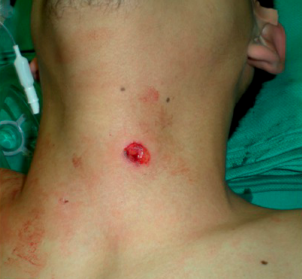
ResponseNo explanation provided
PromptApproach to Intubation in neck trauma
ResponseSit patient upright and apply oxygen as tolerated + allow patient to adopt comfortable position
Understand that this patient needs emergent airway to be secured ideally in a controlled environment (Operating theatre) and the need to contact anaesthetics and ENT for urgent support. Options of gaseous induction or fibreoptic intubation with surgical backup. Analgesia
Antiemetics
Be prepared for RSI if patient deteriorates further and assess for surgical airway through front of neck access
Avoid BVM as it can potentially distort neck anatomy
Nebulised adrenaline +/- IV steroids
IV glycopyrrolate to decrease secretions
Understand that this patient needs emergent airway to be secured ideally in a controlled environment (Operating theatre) and the need to contact anaesthetics and ENT for urgent support. Options of gaseous induction or fibreoptic intubation with surgical backup. Analgesia
Antiemetics
Be prepared for RSI if patient deteriorates further and assess for surgical airway through front of neck access
Avoid BVM as it can potentially distort neck anatomy
Nebulised adrenaline +/- IV steroids
IV glycopyrrolate to decrease secretions