TRAUMA - ADULT
FACE/LE FORT FRACTURE
PromptDescribe your approach to analgesia in gnarly facial injury
Response
- Judicious (comment or appropriate doses mentioned) analgesia as to avoid complications.
- Plan to manage pain whilst maintaining airway tone, respiratory drive and preserving cardiorespiratory physiology (avoid hypoxia, hypotension) (1 mark)
- Fentanyl over morphine (0.5 mark) – cardioprotective, short half life
- Ketamine (0.5 mark) but comment complications e.g., sub-dissociative behaviour difficulty, physiological preservation cannot be relied upon etc (0.5 mark)
- Adjunctive antiemetics (0.5 mark)
PromptDescribe your airway plan in gnarly facial injury
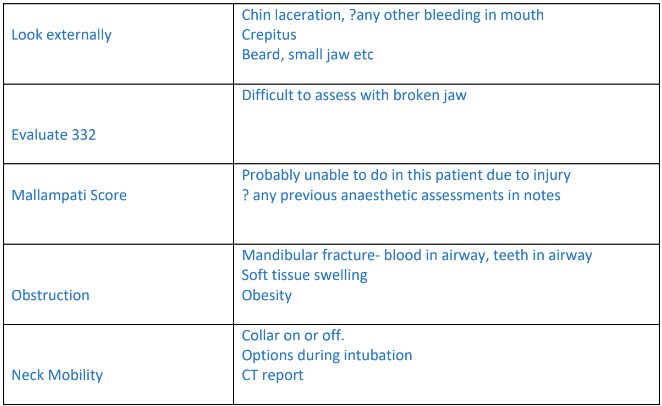
ResponseDifficult airway (0.5 mark)
Optimise position, consider C-spine (0.5 mark)
Anticipate worsening haemorrhage post induction/paralysis (0.5 mark), double suction setup (0.5 mark)
Double airway setup (laryngoscopy + FRONA) (1 mark)
Direct laryngoscopy superior video laryngoscopy (0.5 mark) (Because blood will cover the lens on CMAC)
LMA and BVM high risk failure → early commitment CICO = FRONA (0.5 mark)
Optimise position, consider C-spine (0.5 mark)
Anticipate worsening haemorrhage post induction/paralysis (0.5 mark), double suction setup (0.5 mark)
Double airway setup (laryngoscopy + FRONA) (1 mark)
Direct laryngoscopy superior video laryngoscopy (0.5 mark) (Because blood will cover the lens on CMAC)
LMA and BVM high risk failure → early commitment CICO = FRONA (0.5 mark)
PromptOptions for haemostasis in gnarly facial injury
ResponseCT imaging including arterial phase – potential interventional radiology (0.5 mark)
Damage control surgery / theatre (0.5 mark)
Damage control surgery / theatre (0.5 mark)
PromptName and describe midface fracture grading/classification system
ResponseLeFort
- Le Fort type 1; floating palate, horizontal (0.5-mark name and 0.5-mark adequate descriptor)
- horizontal maxillary fracture, separating the teeth from the upper face
- fracture line passes through the alveolar ridge, lateral nose and inferior wall of the maxillary sinus
- Le Fort type 2; floating maxilla, pyramidal (0.5-mark name and 0.5-mark adequate descriptor)
- pyramidal fracture, with the teeth at the pyramid base, and nasofrontal suture at its apex
- fracture arch passes through the posterior alveolar ridge, lateral walls of maxillary sinuses, inferior orbital rim and nasal bones
- uppermost fracture line can pass through the nasofrontal junction or the frontal process of the maxilla
- Le Fort type 3; floating face, transverse (0.5-mark name and 0.5-mark adequate descriptor)
- craniofacial disjunction
- transverse fracture line passes through nasofrontal suture, maxillo-frontal suture, orbital wall, and zygomatic arch / zygomaticofrontal suture
PromptENT/MAXFAX/DENTAL
Mandible anatomy as a reminder… I forgot most of this so have included it – useful for XR descriptions
Mandible anatomy as a reminder… I forgot most of this so have included it – useful for XR descriptions
Response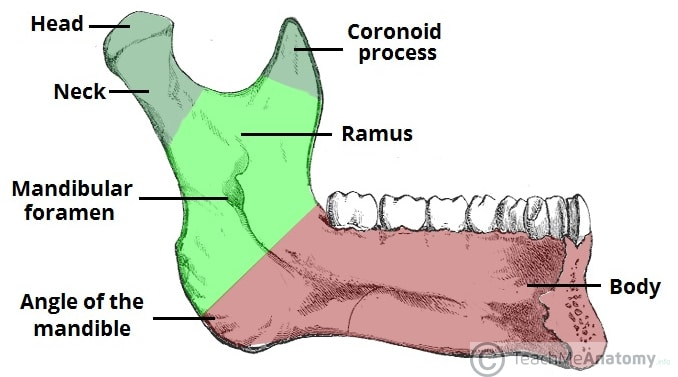
Prompt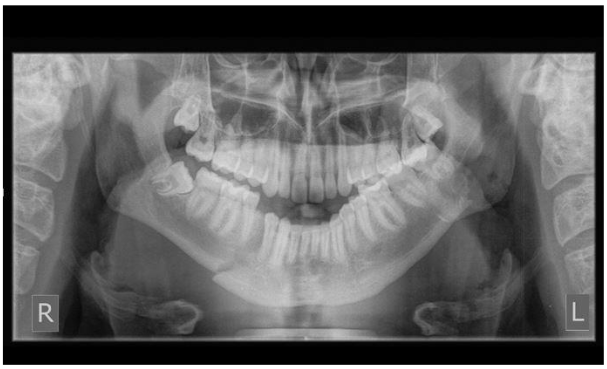
Responseright para-symphaseal # - mildly displaced
# body mandible left-displaced
Malocculsion teeth
# body mandible left-displaced
Malocculsion teeth
Prompt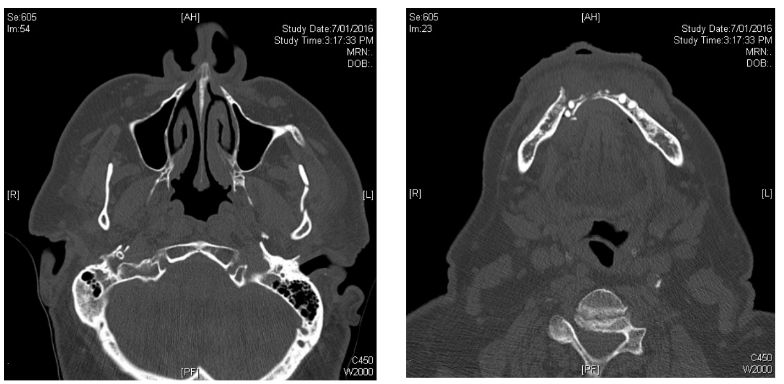
ResponseComminuted fracture of the right body of the mandible
Sockets of teeth affected 43, 44, 45,with considerable displacement
Oblique fracture at the LEFT ramus of the mandible at base of condylar process extending to the upper portion of the coronoid process, minor comminution and separation
Sockets of teeth affected 43, 44, 45,with considerable displacement
Oblique fracture at the LEFT ramus of the mandible at base of condylar process extending to the upper portion of the coronoid process, minor comminution and separation
PromptImportant examination findings in mandible fractures
Responsedegree of mouth opening
occulsion of teeth/ loose or missing teeth
? open fracture into mouth
haematoma floor mouth
swelling/bruising
evidence other facial fractures clinically
inferior alveolar nerve parasthesia (sensory innervation to the lower/mandibular teeth and their corresponding gingiva as well as a small area of the face)
occulsion of teeth/ loose or missing teeth
? open fracture into mouth
haematoma floor mouth
swelling/bruising
evidence other facial fractures clinically
inferior alveolar nerve parasthesia (sensory innervation to the lower/mandibular teeth and their corresponding gingiva as well as a small area of the face)
PromptED management of mandible Fracture
ResponseAntibiotics –benzylpenicillin 1.2g QID + metronidazole 500mg BD IV
ADT if not up to date
Analgesia- IV titrated opiates (name one)
mouthwashes- QID hydrogen peroxide
NBM + IV fluids
Plastics/MaxFax referral
ADT if not up to date
Analgesia- IV titrated opiates (name one)
mouthwashes- QID hydrogen peroxide
NBM + IV fluids
Plastics/MaxFax referral
PromptMandible fracture airway difficulties
Response