TRAUMA - ADULT
HEAD INJURY - ADULT
PromptInduction drugs – head injury
ResponseFentanyl/Midazolam or Ketamine (doses)
Suxamethonium or Rocuronium (doses)
Suxamethonium or Rocuronium (doses)
PromptMeasures to prevent secondary brain injury in intracranial bleed
(Note pretty much all answers the same irrespective of type of bleed or age of patient – ie. Same in Paeds but doses might be a little different)
(Note pretty much all answers the same irrespective of type of bleed or age of patient – ie. Same in Paeds but doses might be a little different)
ResponseBasically: Avoid hypotension, make all obs as normal as possible, head up 30 deg, and ETCO2 35-40, + routine tubed patient care stuff
URGENT NEUROSURGICAL REFERRAL (don’t assume its done)
Maintain low end normocarbia - pCO2 35-40 (answers vary from 30-40 – aim ETCO2 = 35 seems appropriate)
Position 30 degrees head up = Prevent further raised ICP from venous pressure
Ensure ETT ties and cervical collar not tight (REMOVE if able) = Prevent further raised ICP from venous pressure
Maintain normoglycaemia –dextrose or insulin as needed = Keep by BSL between 6-10mmol/L
Maintain normothermia Keep core temperature between 35-37 degrees with Bair Hugger, warm fluids or antipyretics
Maintain optimal BP with fluids (N saline 500ml boluses) or vasopressors as indicated. Avoid hypertension (see below) = Keep MAP 70-85mmHg
Ensure adequate sedation and paralysis eg propofol 5-10mg/hr and vecuronium 10mg = Avoid/treat hypertension, agitated, coughing, gagging due to under sedation/paralysis, all of which will further increase ICP
Maintain adequate oxygenation = Adjust FiO2 to achieve sats >95% and avoid hyperoxia (<99%)
Treat seizures - midaz 5mg if seizing, then phenytoin 20mg/kg = Avoid further brain injury from seizure activity - no evidence to support prophylactic anti-epileptics (Seizure prophylaxis is infrequently indicated, and the course is 7 days only)
Routine Care
Decompress bladder with IDC = Avoid hypertension due to bladder distension
Decompress stomach = Minimise risk of aspiration, optimise ventilation
Treat anaemia = Keep Hb >10g/dl to ensure adequate O2 delivery, transfuse blood as needed
Controversial measures = Decompressive craniectomy, Hypothermia, Dexamethasone
URGENT NEUROSURGICAL REFERRAL (don’t assume its done)
Maintain low end normocarbia - pCO2 35-40 (answers vary from 30-40 – aim ETCO2 = 35 seems appropriate)
Position 30 degrees head up = Prevent further raised ICP from venous pressure
Ensure ETT ties and cervical collar not tight (REMOVE if able) = Prevent further raised ICP from venous pressure
Maintain normoglycaemia –dextrose or insulin as needed = Keep by BSL between 6-10mmol/L
Maintain normothermia Keep core temperature between 35-37 degrees with Bair Hugger, warm fluids or antipyretics
Maintain optimal BP with fluids (N saline 500ml boluses) or vasopressors as indicated. Avoid hypertension (see below) = Keep MAP 70-85mmHg
Ensure adequate sedation and paralysis eg propofol 5-10mg/hr and vecuronium 10mg = Avoid/treat hypertension, agitated, coughing, gagging due to under sedation/paralysis, all of which will further increase ICP
Maintain adequate oxygenation = Adjust FiO2 to achieve sats >95% and avoid hyperoxia (<99%)
Treat seizures - midaz 5mg if seizing, then phenytoin 20mg/kg = Avoid further brain injury from seizure activity - no evidence to support prophylactic anti-epileptics (Seizure prophylaxis is infrequently indicated, and the course is 7 days only)
Routine Care
Decompress bladder with IDC = Avoid hypertension due to bladder distension
Decompress stomach = Minimise risk of aspiration, optimise ventilation
Treat anaemia = Keep Hb >10g/dl to ensure adequate O2 delivery, transfuse blood as needed
Controversial measures = Decompressive craniectomy, Hypothermia, Dexamethasone
PromptBlood pressure control in ICH
ResponseAim BP <140/100
Labetalol 5-10 mg Q10 min
Hydralazine 5mg Q10 min
Metoprolol 2.5-5mg IV Q10 min
Labetalol 5-10 mg Q10 min
Hydralazine 5mg Q10 min
Metoprolol 2.5-5mg IV Q10 min
- NSLHD guidelines – note some BP targets say SBP <160
PromptOther important management priorities in head injury
ResponseC spine immobilisation & spinal board
Secure IV access and invasive monitoring of BP prior to flight
FAST scan to assess for intra-abdominal bleeding (if possible pre-hospital)
Immobilisation of any limb fractures
Antibiotics cover for compound fractures (Cephazolin 2g IV)
Secure IV access and invasive monitoring of BP prior to flight
FAST scan to assess for intra-abdominal bleeding (if possible pre-hospital)
Immobilisation of any limb fractures
Antibiotics cover for compound fractures (Cephazolin 2g IV)
PromptList fancy shit you can do for ICH on Dabigatran and aspirin
ResponseBlood products if required – Packed RBC, Platelets
PRBC for severe anaemia/ongoing blood loss
Platelet transfusion for thrombocytopaenia and/or severe platelet dysfunction
Tranexamic Acid (antifibrinolytic agent)
Low cost and risk (of thrombosis, adverse reaction), therefore should be considered
Desmopressin
Low cost and risk as above
Idarucizumab – only specific reversal agent available for DOACs at present
Currently the only FDA approved agent for reversal of DOACs; only works for dabigatran. Shown to reverse the anticoagulant effect in lab testing and within minutes. Hameostasis without significant thrombosis risk
Prothrombin Complex Concentrates (PCC) :
Three Factor PCCs (factors II, IX, X) - prothrombinex
Four Factor PCCs (II, VII, IX, X) – which can be inactive (octaplex) or active (FEIBA (Factor Eight Inhibitor Bypassing Activity) )
Generally would not give if Idarucizumab has been given. Would consult Haemtology.
Controversial results in in vitro and animal studies. I would discuss with Haematology before prescribing – need to balance risk of thrombosis.
Other points:
Recombinant Factor VIIa (Novoseven) - Not recommended in treatment of DOACs due to high doses required and therefore concern for possibility of thrombotic sequelae.
FFP is not recommended for reversal of DOACs unless no other agent is available
Haemodialysis – Dabigatran is 80-85% renally excreted. (Not useful in Direct Factor Xa oral Inhibitors eg rivaroxaban, apixaban as only 25-35% renal excretion; they are mostly protein bound)
Charcoal if ingested <2hrs prior – reduces absorption
PRBC for severe anaemia/ongoing blood loss
Platelet transfusion for thrombocytopaenia and/or severe platelet dysfunction
Tranexamic Acid (antifibrinolytic agent)
Low cost and risk (of thrombosis, adverse reaction), therefore should be considered
Desmopressin
Low cost and risk as above
Idarucizumab – only specific reversal agent available for DOACs at present
Currently the only FDA approved agent for reversal of DOACs; only works for dabigatran. Shown to reverse the anticoagulant effect in lab testing and within minutes. Hameostasis without significant thrombosis risk
Prothrombin Complex Concentrates (PCC) :
Three Factor PCCs (factors II, IX, X) - prothrombinex
Four Factor PCCs (II, VII, IX, X) – which can be inactive (octaplex) or active (FEIBA (Factor Eight Inhibitor Bypassing Activity) )
Generally would not give if Idarucizumab has been given. Would consult Haemtology.
Controversial results in in vitro and animal studies. I would discuss with Haematology before prescribing – need to balance risk of thrombosis.
Other points:
Recombinant Factor VIIa (Novoseven) - Not recommended in treatment of DOACs due to high doses required and therefore concern for possibility of thrombotic sequelae.
FFP is not recommended for reversal of DOACs unless no other agent is available
Haemodialysis – Dabigatran is 80-85% renally excreted. (Not useful in Direct Factor Xa oral Inhibitors eg rivaroxaban, apixaban as only 25-35% renal excretion; they are mostly protein bound)
Charcoal if ingested <2hrs prior – reduces absorption
PromptList complications of head trauma and their clinical signs
ResponseImpact Apnoea
Increased ICP
Neurogenic pulmonary oedema
CSF leak
Haemorrhagic shock (Neonates)
Increased ICP
- Anisocoria, altered mental state, hypertension, bradycardia, papilloedema, decorticate/decerebrate posturing
- Battle sign (Postauricular haemorrhage)
- Hemotympaanum
- CSF otorrhoea/rhinorrhoea
- Subconjunctival haemorrhage
- Visual loss/deficit, reduced eye movement, facial asymmetry
- Decreased GCS, Seizure
- Reduced air entry, hypoxia, tachycardia, fever, tachypnoea
Neurogenic pulmonary oedema
- Hypoxia, creps, tachypnoea
CSF leak
Haemorrhagic shock (Neonates)
PromptList High and low risk features of Canadian CT head rules
ResponseHIGH RISK (5) – may need neurosurgical intervention (ie: Scan them)
GCS <15 at 2h after injury
suspected open or depressed skull #
any sign of basal skull #: haemotympanum, 'racoon' eyes, CSF otorrohoea/rhinorrhoea, battle's sign
vomiting > or +2 episodes
age >65yo
MEDIUM RISK (2) – May need admission (ie: probably scan them)
Amnesia before impact >30min
dangerous mechanism (pedestrian v. MVA, ejection from vehicle, fall from height >3ft or 5 stairs)
EXCLUSION CRITERIA
Thinners, Age <16, Seizure post injury
If no high/medium risk, and no exclusion criteria CT not required
GCS <15 at 2h after injury
suspected open or depressed skull #
any sign of basal skull #: haemotympanum, 'racoon' eyes, CSF otorrohoea/rhinorrhoea, battle's sign
vomiting > or +2 episodes
age >65yo
MEDIUM RISK (2) – May need admission (ie: probably scan them)
Amnesia before impact >30min
dangerous mechanism (pedestrian v. MVA, ejection from vehicle, fall from height >3ft or 5 stairs)
EXCLUSION CRITERIA
Thinners, Age <16, Seizure post injury
If no high/medium risk, and no exclusion criteria CT not required
PromptList indications for CT brain
Hint: List criteria in CT decision making rules
Hint: List criteria in CT decision making rules
ResponseReduced GCS
Focal neurological signs
On anti-coagulation
Signs BOS # or depressed skull fracture
Vomiting
amnesia
Anything else reasonable
Focal neurological signs
On anti-coagulation
Signs BOS # or depressed skull fracture
Vomiting
amnesia
Anything else reasonable
PromptEPIDURAL HAEMORRHAGE
ResponseBleeding from Middle Meningeal artery (And a few rare others)
Prompt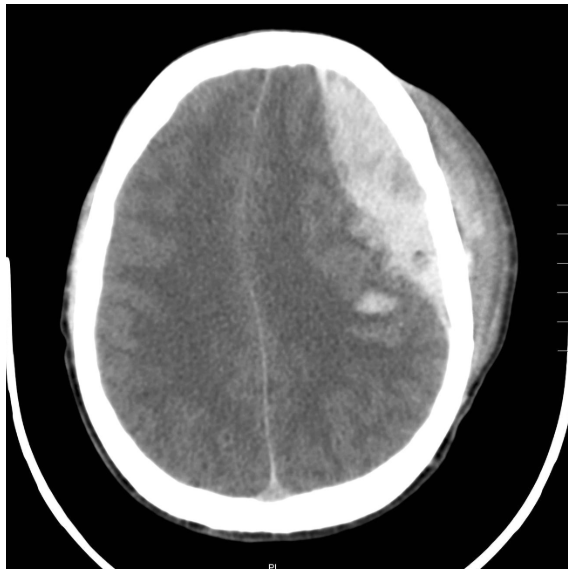
ResponseLarge extradural haematoma – high density bi convex lesion left temporal region
Parietal cerebral contusion left
Significant midline shift to right
Loss of sulci and gyri consistent with raised intracranial pressure
Mgmt = Urgent neurosurgical referral for surgical drainage of haematoma
- Acute (hyperdense)
- Swirl sign (decreased density in dense area indicative of rapid bleeding)
Parietal cerebral contusion left
Significant midline shift to right
Loss of sulci and gyri consistent with raised intracranial pressure
Mgmt = Urgent neurosurgical referral for surgical drainage of haematoma
Prompt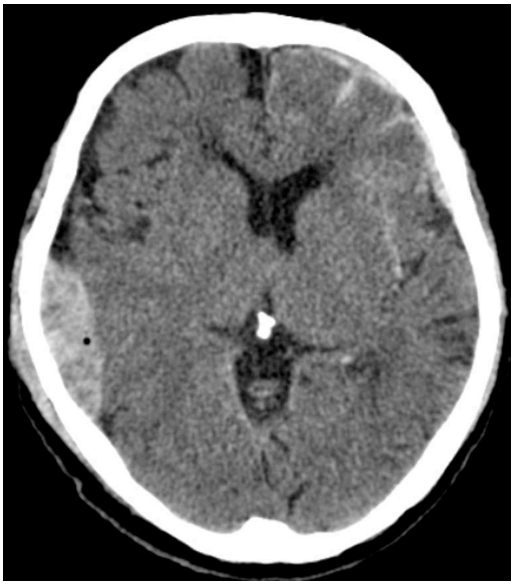
ResponseRight parietal extradural haematoma (can describe bi-convex density and other features but need to say it is an EDH)
Air within EDH
Overlying scalp haematoma
Sub-arachnoid haematoma left frontal, likely contre-coup injury
Mass effect
Effacement of sulci right parietal
No appreciable mid-line shift
Air within EDH
Overlying scalp haematoma
Sub-arachnoid haematoma left frontal, likely contre-coup injury
Mass effect
Effacement of sulci right parietal
No appreciable mid-line shift
PromptSUBDURAL HAEMORRHAGE
ResponseBleeding from Bridging veins (which drain brain to dural sinuses)
PromptInterpret all these scans: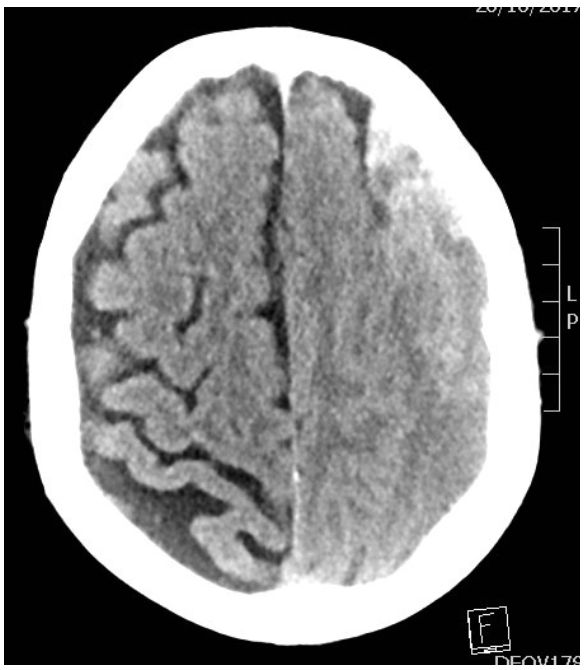
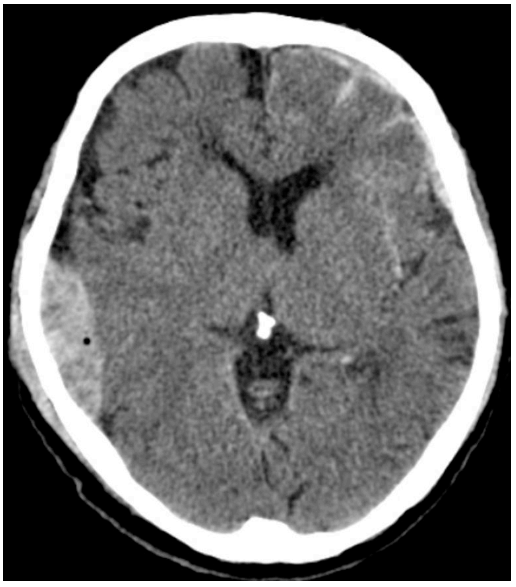
Response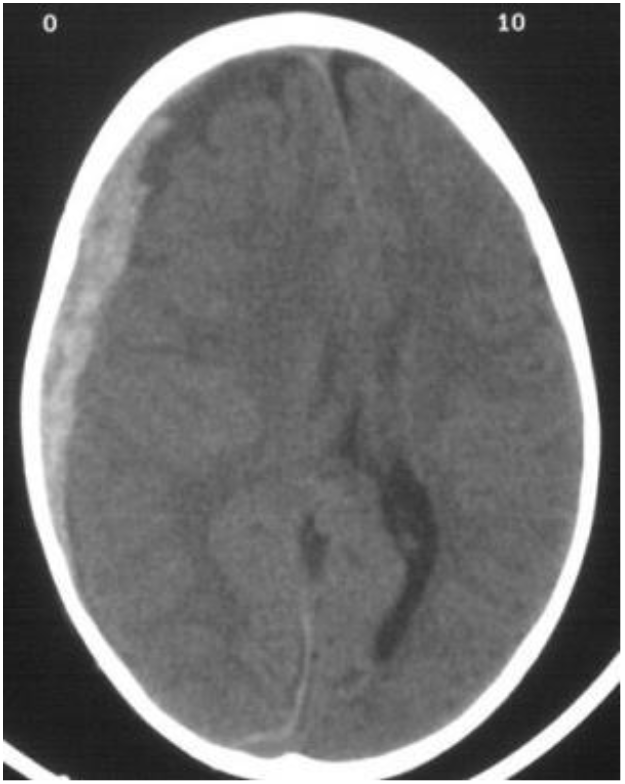
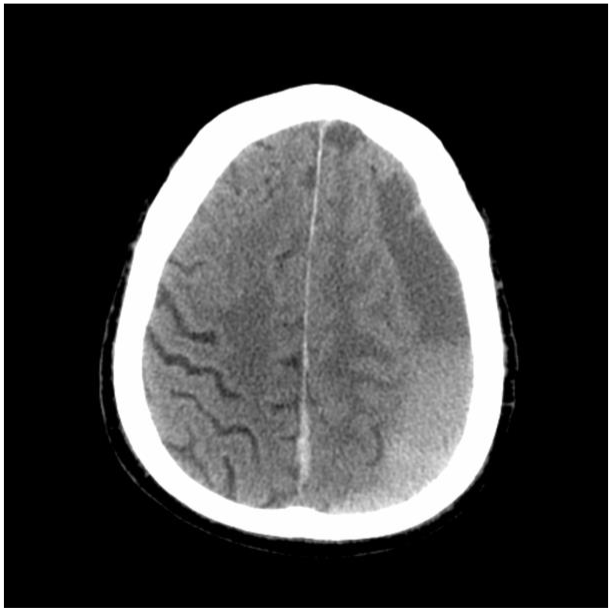
Scan 1: Acute on subacute subdural haematoma / haemorrhage
High attenuation anterior – acute blood
Iso-attenuation – subacute blood
Loss of sulci left hemisphere – raised ICP
Scan 2: Right parietal extradural haematoma (can describe bi-convex density and other features but need to say it is an EDH)
Air within EDH
Overlying scalp haematoma
Sub-arachnoid haematoma left frontal, likely contre-coup injury
Mass effect
Effacement of sulci right parietal
No appreciable mid-line shift
Scan 3: Acute on chronic left subdural haemorrhage overlying the left cerebral convexity, tentorium and parafalcine location. Maximal thickness of this SDH is 23mm
Mass effect with 5mm shift of midline structures to the right and early hydrocephalus
Scan 4: Acute Right subdural haematoma
Midline shift to left
Effacement of R lateral ventricle
Scan 1: Acute on subacute subdural haematoma / haemorrhage
High attenuation anterior – acute blood
Iso-attenuation – subacute blood
Loss of sulci left hemisphere – raised ICP
Scan 2: Right parietal extradural haematoma (can describe bi-convex density and other features but need to say it is an EDH)
Air within EDH
Overlying scalp haematoma
Sub-arachnoid haematoma left frontal, likely contre-coup injury
Mass effect
Effacement of sulci right parietal
No appreciable mid-line shift
Scan 3: Acute on chronic left subdural haemorrhage overlying the left cerebral convexity, tentorium and parafalcine location. Maximal thickness of this SDH is 23mm
Mass effect with 5mm shift of midline structures to the right and early hydrocephalus
Scan 4: Acute Right subdural haematoma
Midline shift to left
Effacement of R lateral ventricle
PromptManagement of Blown pupil, Hypertensive, bradycardic
ResponseHyperventilate to pCO2 30-35
Give mannitol 20% 0.5-1g/kg
Give hypertonic saline e.g. 250ml of 3% saline (3 mL/kg)
Expedite neurosurgeons/transfer
Give mannitol 20% 0.5-1g/kg
Give hypertonic saline e.g. 250ml of 3% saline (3 mL/kg)
Expedite neurosurgeons/transfer
PromptIndication for surgery in SDH
Response- haematoma thickness >10 mm
- > 5mm midline shift regardless of GCS
- GSC < 8
- drop in GCS ≥ 2 points
- development of papillary inequality
- > 5mm midline shift regardless of GCS
- GSC < 8
- drop in GCS ≥ 2 points
- development of papillary inequality
PromptCONTUSION
Response
Prompt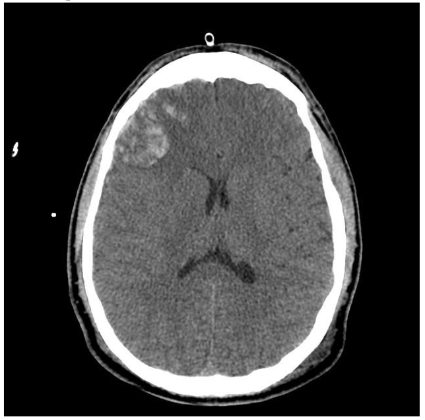
ResponseCT findings:
Right fronto-temporal cerebral contusion
Small associated SDH
Left parietal-occipital soft tissue haematoma
Underlying skull fracture (left parietal) without EDH
Right fronto-temporal cerebral contusion
Small associated SDH
Left parietal-occipital soft tissue haematoma
Underlying skull fracture (left parietal) without EDH
PromptORBIT TRAUMA
ResponseTypically punched in the face or ball vs eye
PromptImportant historical features of facial trauma
Response
- Confirm mechanism of injury
- Symptoms- pain, local tenderness, diplopia, crepitus after nose blowing
- Epistaxis, ptosis and local tenderness
- Restricted eye movements
- Complete eye examination- ocular injury (hyphema, sub conjunct haem, retinal detachment)
- Infraorbital n involvement
- Other facial trauma
PromptImportant examination in facial trauma
Response
- Eye exam
- IOP – Hyphaema with resultant raised IOP/glaucoma
- Visual Acuity – commotio with retinal haemorrhage, concerning for significant eye pathology
- EOM – entrapment with loss of upward gaze due to blowout fracture
- Slit Lamp – hyphaema
- Diplopia from blowout fracture (ie enopthalmus) - diplopia on upward gaze = Inferior rectus entrapment
- Ear exam
- Tympanic Membrane perforation
- Dental exam
- Dental Fractures/trauma requiring specific cares
- Mandibular exam to exclude fracture ie malocclusion/trismus
- C-spine exam
- Midline tenderness or peripheral neurologic signs concerning for nerve root injury/cord injury
- Nasal exam to exclude fracture/ septal haematoma
- Facial sensation to exclude infraorbital nerve dysfunction
- Examination for base of skull fracture (any specific sign)
- Assessment of GCS/consciousness – intracranial injury
- Cervical spine assessment = C-spine fracture
PromptList causes of traumatic optic neuropathy
Response
- Compressive optic neuropathy (retrobulbar haemorrhage, orbital foreign body or orbital emphysema)
- Optic n sheath haematoma
- Optic n head avulsion
- Optic n laceration
PromptXray findings of inferior orbital wall fracture
Response
- Fluid in the maxillary sinus
- Orbital emphysema
- ‘Tear drop sign’- herniation of fat inferiorly
PromptInterpret these scans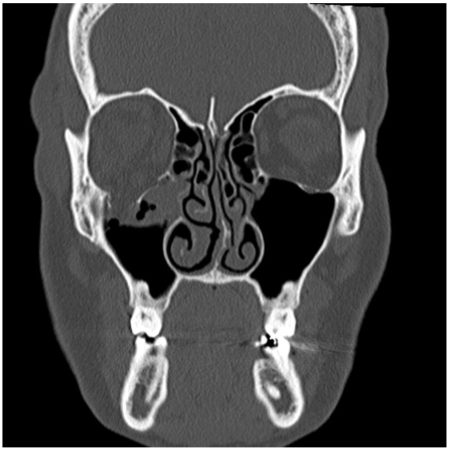
Response1. Inferiorly displaced left orbital floor fracture
Fluid (blood) in left maxillary sinus
Inferior rectus is displaced in to fracture segment – will accept entrapped
2. Fracture and displacement of inferior wall of R orbit
Herniation of orbital contents into maxillary sinus
Fluid in maxillary sinus
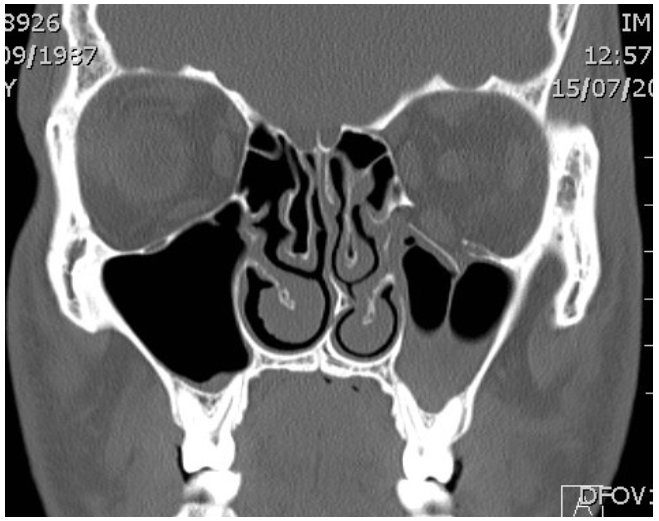
Fluid (blood) in left maxillary sinus
Inferior rectus is displaced in to fracture segment – will accept entrapped
2. Fracture and displacement of inferior wall of R orbit
Herniation of orbital contents into maxillary sinus
Fluid in maxillary sinus
There are probably 50 odd CT brains in past exams to interpret. Be slick.
See also Neuro