ORTHOPAEDICS - ADULT
TIB/FIB FRACTURE
This is where the compartment syndrome will be
PromptManagement of open tib/fib fracture
ResponseHaemorrhage control - direct pressure
Analgesia (Opioids + dose or ketamine)
Consent for sedation/reduction
Procedural sedation
Scrub and irrigate wounds
Fracture reduction
Immobilise in above knee cast
Elevate to reduce risk of compartment syndrome (+Swelling)
IV antibiotics - Cefepime and metronidazole if farm
ADT/tetanus toxoid
Admit orthopaedics for fixation and washout
Analgesia (Opioids + dose or ketamine)
Consent for sedation/reduction
Procedural sedation
Scrub and irrigate wounds
Fracture reduction
Immobilise in above knee cast
Elevate to reduce risk of compartment syndrome (+Swelling)
IV antibiotics - Cefepime and metronidazole if farm
ADT/tetanus toxoid
Admit orthopaedics for fixation and washout
PromptArterial pressure index
ResponseAPI = Injured SBP/Uninjured brachial SBP
API <0.9 is indicative of likely vascular injury - requires vascular surgical review or transfer to center with vascular surgery
Ipsilateral DP or tibial pulse is detected with doppler until clearly heard
Cuff pumped up 20 mm past point where dopplers disappear. Release cuff and measure where sound is heard (Systolic pressure)
Repeat for uninjured lower extremity and uninjured upper extremity
API <0.9 is indicative of likely vascular injury - requires vascular surgical review or transfer to center with vascular surgery
Ipsilateral DP or tibial pulse is detected with doppler until clearly heard
Cuff pumped up 20 mm past point where dopplers disappear. Release cuff and measure where sound is heard (Systolic pressure)
Repeat for uninjured lower extremity and uninjured upper extremity
Prompt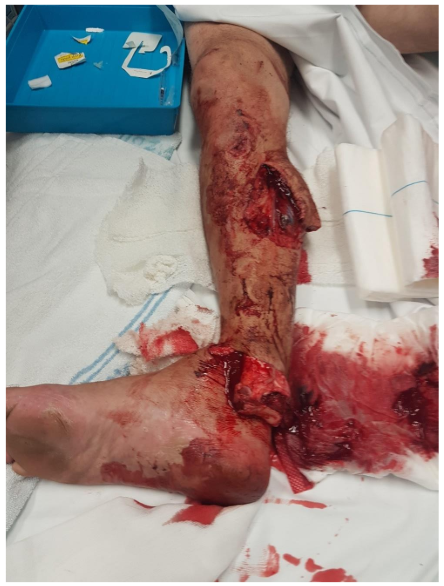
ResponseImage Description:
Open fracture / dislocation left ankle
Profound displacement (90o external rotation)
Large wound with high potential for contamination
Minimal active bleeding
Left calf flap wound
Assessment Priorities:
Identify life-threatening injuries = primary survey
Neurovascular status of limb / assessment of obvious injury
Management Priorities:
Analgesia: Titrated fentanyl IV +.- low-dose ketamine
IV Antibiotics (broad-spectrum given size of wound) / ADT
Reduction of fracture dislocation under sedation with immobilisation and re-evaluation of neurovascular status
Admission to hospital:
Open fracture / dislocation left ankle
Profound displacement (90o external rotation)
Large wound with high potential for contamination
Minimal active bleeding
Left calf flap wound
Assessment Priorities:
Identify life-threatening injuries = primary survey
Neurovascular status of limb / assessment of obvious injury
- Pulse / doppler assessment
- Define anatomy of bony injury with Xray
Management Priorities:
Analgesia: Titrated fentanyl IV +.- low-dose ketamine
IV Antibiotics (broad-spectrum given size of wound) / ADT
- Gustillo-Anderson classification 3
Reduction of fracture dislocation under sedation with immobilisation and re-evaluation of neurovascular status
Admission to hospital:
- Vascular surgery input immediately if vascular compromise post-reduction
- Orthopaedic Admission with view to definitive ORIF / washout in OT emergently
PromptCOMMON PERONEAL NERVE INJURY
Response
PromptMotor and sensory of common peroneal nerve
ResponseMotor
- Dorsiflexion ankle and great toe, Eversion of foot
- Dorsum foot, lateral leg below knee
PromptCommonest site of injury CPN
ResponseAt fibular head
PromptCauses of common peroneal nerve injury
ResponseHigh ankle sprain
Fractured fibular
Tight plaster involving knee
Wearing hih knee boots
Prolonged bedrest/coma with pressure at knee
Habitual leg crossing
TKR
High tibial osteotomy
That time I injected local into that guys knee after a tibial plateau fracture and accidentally blocked his tibial nerve giving him a 48 hour foot drop
Fractured fibular
Tight plaster involving knee
Wearing hih knee boots
Prolonged bedrest/coma with pressure at knee
Habitual leg crossing
TKR
High tibial osteotomy
That time I injected local into that guys knee after a tibial plateau fracture and accidentally blocked his tibial nerve giving him a 48 hour foot drop
PromptDifference to L5 radiculopathy
ResponseInversion and plantarflexion should be preserved
Decreased or absent ankle reflex in radiculopathy
Decreased or absent ankle reflex in radiculopathy