CARDIOLOGY - ECG LIBRARY
Case 13
74 F, Light headed, palpitations. BG PPM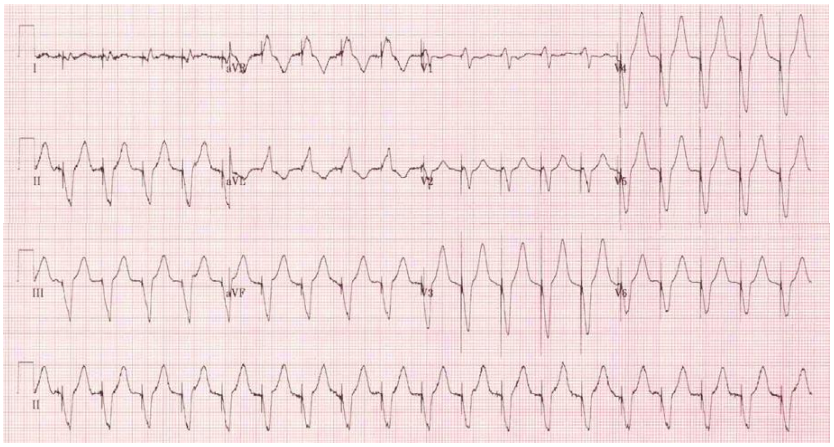
Expected Response
Broad complex tachycardia (HR 120/min) with a ventricular pacing spike before every complex.
ii. Absence of p wave before each ventricular pacing spike indicating that the pacemaker is not triggered by a native atrial rhythm.
iii. Absence of atrial spike before each ventricular pacing spike indicating that there is no atrial pacing.
Ddifferential diagnoses
Pacemaker mediated tachycardia (PMT). A re-entry tachycardia is created by the pacemaker forming an anterograde pathway and the AV node acting as a retrograde pathway. The retrograde p wave is sensed as native atrial activity and further ventricular pacing is propogated causing the inappropriate tachycardia.
Sensor-induced tachycardia. The sensor may misfire from ‘noise’ such as vibrations, loud noises, hyperventilation, surgical electrocautery, etc.
ii. Absence of p wave before each ventricular pacing spike indicating that the pacemaker is not triggered by a native atrial rhythm.
iii. Absence of atrial spike before each ventricular pacing spike indicating that there is no atrial pacing.
Ddifferential diagnoses
Pacemaker mediated tachycardia (PMT). A re-entry tachycardia is created by the pacemaker forming an anterograde pathway and the AV node acting as a retrograde pathway. The retrograde p wave is sensed as native atrial activity and further ventricular pacing is propogated causing the inappropriate tachycardia.
Sensor-induced tachycardia. The sensor may misfire from ‘noise’ such as vibrations, loud noises, hyperventilation, surgical electrocautery, etc.