HAEM/ONC
MASSIVE TRANSFUSION
PromptIndications for MTP
ResponseTrauma (in hospital or pre-hospital)
Actual/anticipated >4U PRBC in <4H + unstable/ongoing bleeding
Major Obstetric, GI or surgical bleeding.
Actual/anticipated >4U PRBC in <4H + unstable/ongoing bleeding
Major Obstetric, GI or surgical bleeding.
PromptDefinition of massive transfusion (Adult)
ResponseReplacement of >1 blood volume in 24 hours
>50% of blood volume in 4 hours (blood volume ~70 mL/kg)
>10U in 24h or persistent losses >150 mL/h
Anticipated mass haemorrhage in severe trauma
>50% of blood volume in 4 hours (blood volume ~70 mL/kg)
>10U in 24h or persistent losses >150 mL/h
Anticipated mass haemorrhage in severe trauma
PromptDefinition of massive transfusion (Paediatric)
ResponsePaediatric (multiple definitions - some similar to adult)
By clinical team: >20 mL/kg in 2h with ongoing losses OR >40 mL/kg PRBC in 24h + ongoing
By lab: Child <5 +>2U PRBC in 1hr, >5yo >4U in 1hr
By clinical team: >20 mL/kg in 2h with ongoing losses OR >40 mL/kg PRBC in 24h + ongoing
By lab: Child <5 +>2U PRBC in 1hr, >5yo >4U in 1hr
Prompt3 advantages of MTP vs RBC only in haemorrhagic shock
ResponseImproved mortality
Reduction in volume required to be transfused (Fewer transfusion reactions eg: TACO)
Less wastage of blood products
Reduction in volume required to be transfused (Fewer transfusion reactions eg: TACO)
Less wastage of blood products
PromptGoals of fluid resus in Trauma
ResponsePrevent coagulopathy
Avoid hypothermia
Avoid acidosis
Maintain perfusion to vital orgains - SBP 80 (100 in head injury)
Avoid hypothermia
Avoid acidosis
Maintain perfusion to vital orgains - SBP 80 (100 in head injury)
PromptMassive Transfusion Targets
ResponseHaematological
- Ca2+ >1.1mmol/L
- Platelets >50 x109/L (low = give platelets)
- PT/APTT <1.5 x normal (= give FFP)
- INR <1.5
- Fibrinogen > 1.0g/L (>2.5g/L for PPH) (low = give cryo)
- pH >7.2 (Correct acidosis as worsens coagulopathy)
- Base excess < -6
- Lactate <4mmol/L
- Temp >35°C (Careful if Q asks for lab values. Temp is not a lab value)
PromptEssential elements of massive transfusion protocol
ResponseEarly communication - blood bank, haematology
Baseline lab investigations - FBC, coags, biochem
Clinical triggers
Product ratios 1:1:1
Monitoring and treatment of complications - Acidosis, coagulopathy,hypothermia, Calcium
Documentation
Quality assurance - audit
Baseline lab investigations - FBC, coags, biochem
Clinical triggers
Product ratios 1:1:1
Monitoring and treatment of complications - Acidosis, coagulopathy,hypothermia, Calcium
Documentation
Quality assurance - audit
PromptTXA
ResponseCRASH-2 TRIAL - Tranexamic acid – if < 3 hours from injury. Children under 16y excluded. causes harm if given later than 3 hours
IV: 20mg/kg over 5min; in trauma 1g over 10 min then 1g over 8h IV
IV: 20mg/kg over 5min; in trauma 1g over 10 min then 1g over 8h IV
- LITFL and i think an q somewhere
PromptROTEM pros/cons
ResponsePros
Target blood component replacement >> less overall product use
Less volume >> avoids complications of MTP (thermomodulation, haemodilution, Coagulopathy)
Directed correction of identified coagulopathy >> targeted treatment (EgL Fibrinogen)
Cons
Requires regular sampling + interpretation
Requires specific equipment and interpretation algorithm
Active thinking process vs prescriptive MTP
Target blood component replacement >> less overall product use
Less volume >> avoids complications of MTP (thermomodulation, haemodilution, Coagulopathy)
Directed correction of identified coagulopathy >> targeted treatment (EgL Fibrinogen)
Cons
Requires regular sampling + interpretation
Requires specific equipment and interpretation algorithm
Active thinking process vs prescriptive MTP
Prompt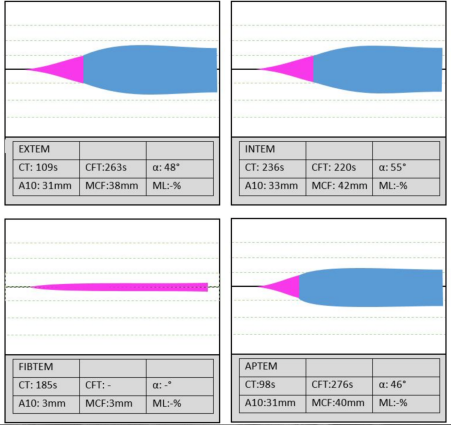
ResponseManagement of this ROTEM
factor replacement = give Fibrinogen 3-4g IV OR cryoprecipitate 20 units IV
Extem = Extrinsic pathway
Intem - Intrinsic pathway - similar to APTT
FibTem = Fibrinogen - <9 = give more, >25 = too much
Aptem - low give TXA
Good article on Deranged Physiology by the Genous Dr. Yartsev who’s also a top bloke!
factor replacement = give Fibrinogen 3-4g IV OR cryoprecipitate 20 units IV
Extem = Extrinsic pathway
Intem - Intrinsic pathway - similar to APTT
FibTem = Fibrinogen - <9 = give more, >25 = too much
Aptem - low give TXA
Good article on Deranged Physiology by the Genous Dr. Yartsev who’s also a top bloke!
PromptTEG interpretation
ResponseIncreased R time >> give FFP
Decreased Alpha angle >> Give Cryoprecipitate
Decreased MA >> Give platelets (+/- DDAVP)
Fibrinolysis >> Give TXA
Decreased Alpha angle >> Give Cryoprecipitate
Decreased MA >> Give platelets (+/- DDAVP)
Fibrinolysis >> Give TXA
PromptBig sick trauma patient results: Most likely cause + immediate management
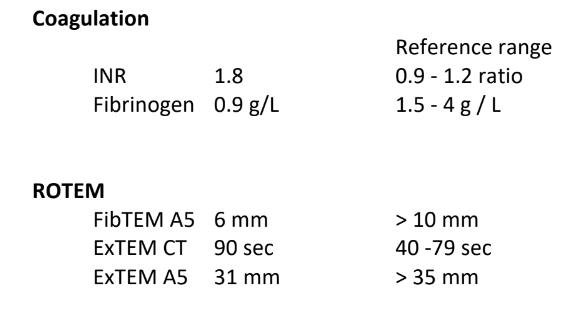
ResponseAcute Traumatic Coagulopathy (or Trauma Induced Coagulopathy)
Immediate management:
Give fibrinogen replacement – Cryoprecipitate (5 bags apheresis cryoprecipitate or 10 bags whole blood cryoprecipitate) or Fibrinogen Concentrate 4gm (any of these is acceptable)
Immediate management:
Give fibrinogen replacement – Cryoprecipitate (5 bags apheresis cryoprecipitate or 10 bags whole blood cryoprecipitate) or Fibrinogen Concentrate 4gm (any of these is acceptable)
PromptComplications of MTP
ResponseCoagulopathy from dilution
Hypothermia
Hyperkalaemia, Hypomagnesaemia
TRALI - Acute onset of fever, chills, dyspnoea, tachypnoea, tachycardia, hypotension, hypoxaemia and noncardiogenic bilateral pulmonary oedema leading to respiratory failure during or within six hours of transfusion. Risk 1:190,000. Potentially fatal. ?antibiody mediated.
TACO - Transfusion associated circulatory overload - pulmonary oedema due to excess volume or circulatory overload >> acute respiratory distress
Hypothermia
Hyperkalaemia, Hypomagnesaemia
TRALI - Acute onset of fever, chills, dyspnoea, tachypnoea, tachycardia, hypotension, hypoxaemia and noncardiogenic bilateral pulmonary oedema leading to respiratory failure during or within six hours of transfusion. Risk 1:190,000. Potentially fatal. ?antibiody mediated.
TACO - Transfusion associated circulatory overload - pulmonary oedema due to excess volume or circulatory overload >> acute respiratory distress