ENVIRONMENTAL
DIVING
Most questions ask about helicopter transfer.
PromptSickness vs illness vs AGE
ResponseDecompression SICKNESS = dissolved nitrogen precipitating to form nitrogen bubbles >> Activation of inflammatory cascade >> Symptoms - the bends/caissons disease etc.
AGE = gas enters blood directly from pulmonary barotrauma.
Decompression ILLNESS is a blanket term ILLNESS = AGE + Decompression SICKNESS
It seems even some of the model answers mess this up from time to time.
AGE = gas enters blood directly from pulmonary barotrauma.
Decompression ILLNESS is a blanket term ILLNESS = AGE + Decompression SICKNESS
It seems even some of the model answers mess this up from time to time.
PromptDecompression SICKNESS
ResponsePathophysiology - Nitrogen bubbles forming in tissues (pressure effects ) in vessels (flow effects) and activation of inflammatory cascade
Gradual onset of neuro, msk, and/or skin symptoms often within 30-60 minutes of surfacing, nearly all within 24 hours.
The Bends = MSK pain, most common - “pain so bad you double over”
The Chokes = dyspnoea, chest pain, cough. Rare
The Staggers = Neurologic - Vertigo to severe CNS symptoms/death
Gradual onset of neuro, msk, and/or skin symptoms often within 30-60 minutes of surfacing, nearly all within 24 hours.
The Bends = MSK pain, most common - “pain so bad you double over”
The Chokes = dyspnoea, chest pain, cough. Rare
The Staggers = Neurologic - Vertigo to severe CNS symptoms/death
PromptBubble size vs altitude and depth
Response10,000 ft = 14 mL
2,000 ft = 11 mL
Sea Level = 10 mL
10m = 5 mL
20 m = 3.3 mL
Follows Boyle's Law - P1V1=P2V2 - This is a law for peasants. Use ideal gas equation like a real scientists you medical pagans (temperature would totally be relevant and contributory to gas reexpansion as now at body temp not water temp). Engineers shouldn’t prescribe drugs. Doctors shouldn’t apply physics. (Although I can do both as I have both pieces of paper and a thesis in fluid dynamics). Also SI units have a space between the number and the units. Whoever reads these notes - thats not in the exam but its important to be a good human.
2,000 ft = 11 mL
Sea Level = 10 mL
10m = 5 mL
20 m = 3.3 mL
Follows Boyle's Law - P1V1=P2V2 - This is a law for peasants. Use ideal gas equation like a real scientists you medical pagans (temperature would totally be relevant and contributory to gas reexpansion as now at body temp not water temp). Engineers shouldn’t prescribe drugs. Doctors shouldn’t apply physics. (Although I can do both as I have both pieces of paper and a thesis in fluid dynamics). Also SI units have a space between the number and the units. Whoever reads these notes - thats not in the exam but its important to be a good human.
PromptHistory to assess risk of decompression illness
ResponseDive history
Number of dives and ascents
Depth of dives
Time spent at bottom
Decompression/safety stops performed, problems with ascent/equalising
Rapid Ascent
Gasses used in SCUBA apparatus
Time of collapse in relation to resurfacing
Non dive history
Dehydration
Strenuous exercise within 4 hours of diving
Cold
Ascent to altitude (flying) too soon after diving
Smoking, alcohol, obesity
PMHx
Especially cardiac/seizures
Prior dive related illness
Medications
Number of dives and ascents
Depth of dives
Time spent at bottom
Decompression/safety stops performed, problems with ascent/equalising
Rapid Ascent
Gasses used in SCUBA apparatus
Time of collapse in relation to resurfacing
Non dive history
Dehydration
Strenuous exercise within 4 hours of diving
Cold
Ascent to altitude (flying) too soon after diving
Smoking, alcohol, obesity
PMHx
Especially cardiac/seizures
Prior dive related illness
Medications
PromptCauses of confusion at depth
ResponseHypoxia - Aspiration, breath holding, gas supply failure
Nitrogen narcosis
Contaminated gas mix - eg: tanks filled near petrol compressors with CO entrainment
Oxygen toxicity - if diving on high O2 gas mixes
Nitrogen narcosis
Contaminated gas mix - eg: tanks filled near petrol compressors with CO entrainment
Oxygen toxicity - if diving on high O2 gas mixes
PromptCause of collapsed diver
ResponseDive related
CAGE/DCI
Toxic gas - CO2, CO, hydrocarbon
Immersion pulmonary oedema
Near drowning
Hypothermia
Marine envenomation - coneshell, box jellyfish/irjukanji, blue ring octopus etc
Non dive related
Hypoglycaemia
Seizure
ICH/CVA
CVS collapse (ACS, arrhythmia, PE
Trauma
Drug/medication intoxication
CAGE/DCI
Toxic gas - CO2, CO, hydrocarbon
Immersion pulmonary oedema
Near drowning
Hypothermia
Marine envenomation - coneshell, box jellyfish/irjukanji, blue ring octopus etc
Non dive related
Hypoglycaemia
Seizure
ICH/CVA
CVS collapse (ACS, arrhythmia, PE
Trauma
Drug/medication intoxication
PromptDifferentials of confusion + unsteady on feet after a dive
ResponseDecompression illness: “The Bends”
- Delayed onset after exiting water, subtle neuro findings (especially retention) associated symptoms (joint pains, rash)
- Onset immediately on surfacing, stroke type neuro findings, other arterial/embolic occlusifve findings. Associated pneumothroax/s/c emphysema
- Exam consistent with peripheral vertigo, positional, rotational sensation, nystagmus
PromptDive pathologies that present shortly after ascent
ResponsePneumothorax/pneumomediastinum
Middle ear pathologies
Sinus pain
Arterial gas embolism (especially Cerebral)
Tooth pain
Abdominal cramps
Middle ear pathologies
Sinus pain
Arterial gas embolism (especially Cerebral)
Tooth pain
Abdominal cramps
Prompt
Response
PromptBody systems that may be affected by decompression illness
(Some q’s say illness, others sickness. Same general answers?)
(Some q’s say illness, others sickness. Same general answers?)
ResponseNeurological - confusion, memory loss, headache, visual disturbance, altered LOC
Spinal - Sensory/motor deficits, urine retention, loss of anal tone
Cardiac/resp - Chest pain, APO, hypoxia
MSK - myalgia/arthralgia (the ‘bends’)
Vestibular - vertigo, tinnitus, hearing loss, ataxia
Skin - Rash
Lymphatic - swelling
Spinal - Sensory/motor deficits, urine retention, loss of anal tone
Cardiac/resp - Chest pain, APO, hypoxia
MSK - myalgia/arthralgia (the ‘bends’)
Vestibular - vertigo, tinnitus, hearing loss, ataxia
Skin - Rash
Lymphatic - swelling
PromptWhat is this
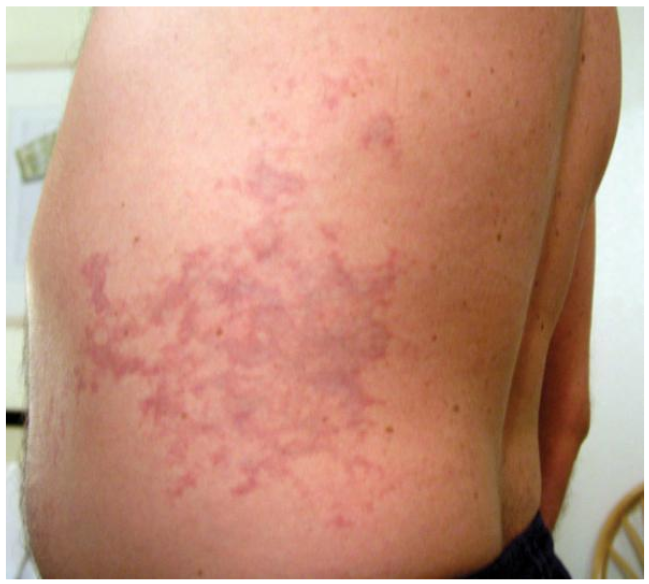
ResponseCutaneous decompression illness - Curtis Marmorata
High chance of progression to neurologic symptoms
(DDx alergic reaction/dermatitis)
High chance of progression to neurologic symptoms
(DDx alergic reaction/dermatitis)
PromptArterial Gas embolism
ResponsePathophysiology - barotrauma - rapid expansion/tear of pulmonary tissue - direct entry of air bubbles into circulation
Usually occur on ascent or immediately upon surfacing
Usually occur on ascent or immediately upon surfacing
PromptThis Xray plus hemiparesis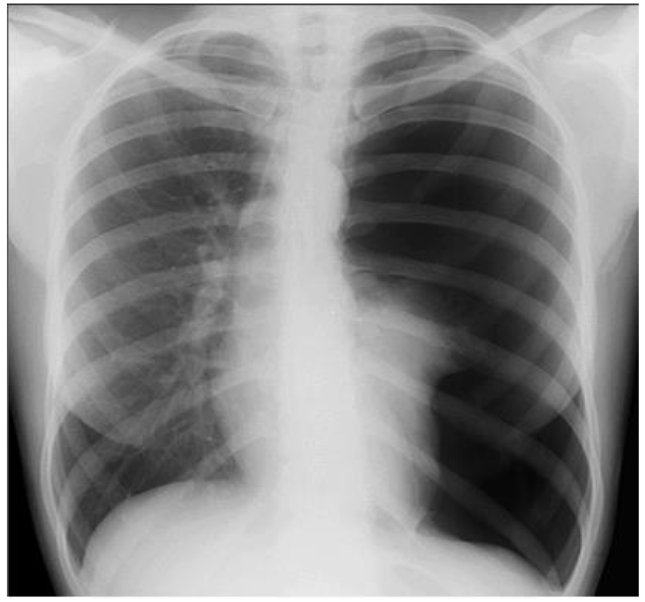
ResponseLeft sided pneumothorax
Cerebral artery gase embolism (CAGE) causing stroke
Unifying diagnosis = Deompression illness/rapid ascent from depth.
Cerebral artery gase embolism (CAGE) causing stroke
Unifying diagnosis = Deompression illness/rapid ascent from depth.
PromptManagement of Decompression sickness
ResponseKeep supine, avoid head up position (helps prevent further emboli)
100% 02 - High flow if able
IV fluids 1L N/S
Drain pneumothorax if present with ICC
Urgently organise transfer to hyperbaric treatment
Assess airway/need for intubation
100% 02 - High flow if able
IV fluids 1L N/S
Drain pneumothorax if present with ICC
Urgently organise transfer to hyperbaric treatment
Assess airway/need for intubation
PromptCAGE investigations
ResponseCT Arch-COW - Exclude atheroscleoris of cerebral vessels
MRI brain - exclude ischaemic cerebral injury
Echocardiogram - ?patent foramen ovale as cause for CAGE
MRI brain - exclude ischaemic cerebral injury
Echocardiogram - ?patent foramen ovale as cause for CAGE
PromptTransfer options
ResponseRoad
- Pro: sea level, Con: Slow
- Pro - presurised cabin, relatively rapid, better for long range transfer as faster
- Con - need t/f to and from airstrips with secondary road transfer
PromptPros/Cons helicopter retrieval for decompression illness
ResponsePros:
Speed - fast interhospital transfer
quick to mobilise
Direct hospital to hospital transfer (if both hospitals have helipad)
Less turbulence than fixed wing
Cons:
Requires ascent to altitude - helicopter cannot be presureised
Vibration - may worsen DCI
Exposure to cold - may worsen DCI
Small cabin space (vs ambulance or fixed wing)
Weather/night may limit flights
Speed - fast interhospital transfer
quick to mobilise
Direct hospital to hospital transfer (if both hospitals have helipad)
Less turbulence than fixed wing
Cons:
Requires ascent to altitude - helicopter cannot be presureised
Vibration - may worsen DCI
Exposure to cold - may worsen DCI
Small cabin space (vs ambulance or fixed wing)
Weather/night may limit flights
PromptHelicopter retrieval Considerations
ResponseMust maintain horizontal position if concerned of CAGE (can’t be seated)
Need to be flown at sea level
Needs High flow O2 - supply may be limited
Delay to recompression leads to poorer outcomes - need urgent transport to center with decompression chamber
Contraindications
DCI/AGE - diving related bubble problems “because of boyles law” - Intracranial/intraspinal air
Other air if not decompressed - PTx, Bowel obstruction
Cardiac arrest requiring compressions (Lucas may allow air transport)
Aggressive, combative patient - risk to aircraft and crew unless sedated
Need to be flown at sea level
Needs High flow O2 - supply may be limited
Delay to recompression leads to poorer outcomes - need urgent transport to center with decompression chamber
Contraindications
DCI/AGE - diving related bubble problems “because of boyles law” - Intracranial/intraspinal air
Other air if not decompressed - PTx, Bowel obstruction
Cardiac arrest requiring compressions (Lucas may allow air transport)
Aggressive, combative patient - risk to aircraft and crew unless sedated